The Essential Characteristics of Strong Outdoor Recreation Economies: Introduction

In this series, Alex Belensz, Senior Associate, Community & Recreation Planning, explores the essential characteristics of strong outdoor recreation economies and the factors that shape their long-term success.
A few years ago, some fellow SE Group recreation planners and I were following a local (George) up an impossibly steep trail in Pennsylvania’s Allegheny Mountains. We were on the Thousand Steps Trail, a former miner’s access trail turned destination for tens of thousands of hikers every year. Prior to our arrival, the Huntingdon County Visitors Bureau had emphasized to us the economic importance of the trail and we’d read articles detailing its backstory and popularity.
Still, we were struck, not only by the scenery, but also the infrastructure: over one thousand stone steps ascending 850 vertical feet in just half a mile, fastening the trail to a crumbly mountainside. We were also struck by another finding: George was maintaining this infrastructure mostly by himself – a herculean, seemingly unending task when loose soils, off trail hikers, and gravity were working overtime to pull the trail down to the Juniata River.
It warmed our hearts to see George’s dedication to the trail. It also made us worry about the fragility of this economic asset – what would happen if there was no George? As we continued our broader tour of the Allegheny Mountains, it turned out that a similar challenge was playing out for other trail system across the region, with implications for community development, quality of life, and business success. In the resulting study of the region’s outdoor economy, we spotlighted trail maintenance as an urgent economic priority. Later that year, Huntingdon County Visitors Bureau started directing hotel tax revenues to a new trail maintenance fund, a small but critical step forward to sustain the county’s outdoor economy.
In this series of posts, we’ll be sharing SE Group’s community-centric framework for understanding and supporting outdoor economies, organized around four key pillars: Natural Lands & Waters, Infrastructure, Businesses, and Community. For each pillar, we’ll share a few common trademarks of economic strength and examples of places finding success.
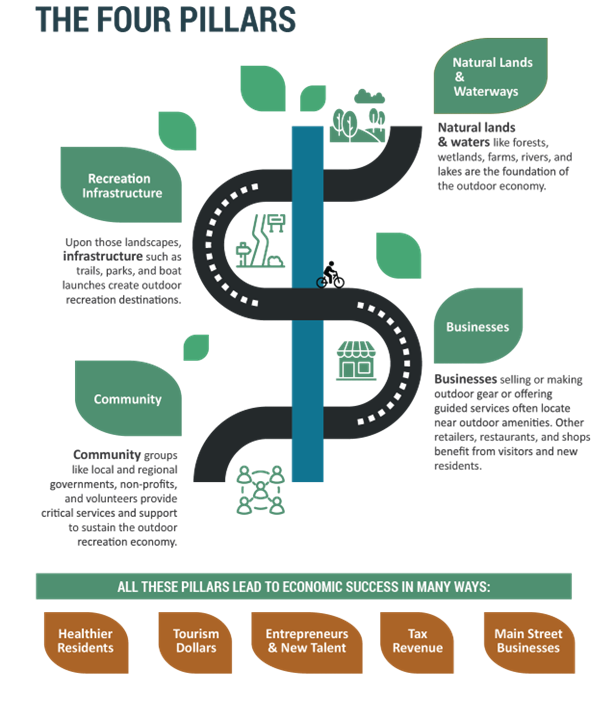
We developed these pillars because it’s difficult to define a “strong” outdoor economy without getting into the details. Success here is context-specific, measured against local economic conditions and goals. That said, we can get this conversation started with a few examples of “strong” economic outcomes, like where outdoor recreation:
- Helps stabilize a community during an economic transition, such as the loss of major industry or institution.
- Contributes strongly to local quality of life, helping to retain and attract residents, businesses, and workers.
- Powers local entrepreneurship, generating wealth that stays in the community.
- Inspires people to live healthy, meaningful, purpose-driven lives.
- Helps sustain rural communities and lifestyles.
In these posts, we’ll explore the factors that drive these outcomes, starting with the places that bring us outdoors and ending with the people (the “Georges”), organizations, and businesses that comprise and steer the economy. Before we dive in, let’s emphasize a few key points:
- Outdoor economies function at a variety of scales. To support actionable planning, we like to study outdoor economies using a regional lens (often a cluster of towns or counties). This helps us build a landscape-scale understanding of the key economic drivers (the Four Pillars!) to inform market opportunities, infrastructure needs, and strategic partnership opportunities.
- Every outdoor economy has its strengths and weaknesses. In our work, we help outdoor economy partners identify and build on their existing strengths and set pragmatic goals, understanding that 1) context matters and 2) progress (not perfection) is the goal.
- This isn’t the only way to evaluate an outdoor economy. For us, it’s a way to break it down into digestible, community-focused components. We find it helpful and hope you do too.


